Director’s cut
6 min read · Director’s cut +6 min
Capstone · BRIDGEGOOD · Responsible AI · 2026
Breakmate
In one study, a chatbot spotted 82% of users in crisis, and only 2.4% called a helpline.
Breakmate is built for that gap. It notices the loop and gets people back to each other, on their own terms.
5 of 5
first-round testers saw value in what Breakmate was trying to do
4 of 5
couldn’t explain our first idea, so we rebuilt the core
3 of 3
round-two testers got through without getting lost, and still found two flow bugs
Eight usability tests over two rounds, August 2026. Small groups, so these are counts, not rates.
Credits
Role
Product Manager / UX Design Apprentice at BRIDGEGOOD
Team
4 (product and design, research, brand, and prototype leads)
Timeline
Jul – Aug 2026
Status
Concept + tested interactive prototype
I owned
Product direction and team coordination, plus the full product design and its design system

In 60 seconds
Short on time? Start here.
The problem
Relief that quietly replaces self-trust
People turn to AI chatbots in moments of doubt. The relief is instant, but every answer that comes from the AI makes it a little harder to trust themselves. No single AI app can see that pattern.
The decision
A layer across AI tools, not another chatbot
We built Breakmate to sit across the assistants people already use. When it spots a reassurance loop, it offers a guided pause and a way to reach someone real.
The result
An end-to-end prototype, tested with 8 people
The prototype runs the whole journey, from onboarding to a guided pause and local support. The next step is a first institutional pilot, such as a university.
Key insight
“The problem wasn’t how much people used AI. It was what they stopped doing for themselves.”
So Breakmate measures repeated questions, not minutes, and every intervention hands control back to the user.
Decisions
Three decisions and what we gave up
Every option below had a real case for it. This is how we chose.
The question
Build another chatbot, or a layer across the AI tools people already use?
We chose
A cross-tool layer. People already use two or three assistants, and single-app safeguards can’t see the full pattern.
What we cut
A standalone wellness chatbot. It would add one more AI to lean on.
The question
What belongs in version one?
We chose
Pattern dashboard, guided pause, limits, and support discovery.
What we cut
In-chat detection. It’s technically riskier, so it moved to the roadmap.
The question
Who pays?
We chose
Free for users, funded by institutions like universities and insurers.
What we cut
Charging users. We didn’t want revenue to depend on people using AI more.

What we cut from version one
A screen for managing every AI connection
I wireframed a place to connect or disconnect each assistant, with tools we couldn’t support yet marked “coming soon.” It wasn’t the core feature, and we had limited time, so we spent that time on loop detection and the guided pause instead.
The same privacy promise, “analysis runs on your device only,” lives on the consent screen in the final prototype.
Early wireframe, not in the final prototype. Tool names and the product name were updated for this page.
The product
Laura’s path through Breakmate
Laura, our persona, is job hunting and keeps asking AI about the same interview feedback. Eight moments take her from onboarding to a real person, and each caption explains a decision.

01 · Onboarding
Say what it is in one line
“All your AI, one place” sets the mental model before we ask for anything.
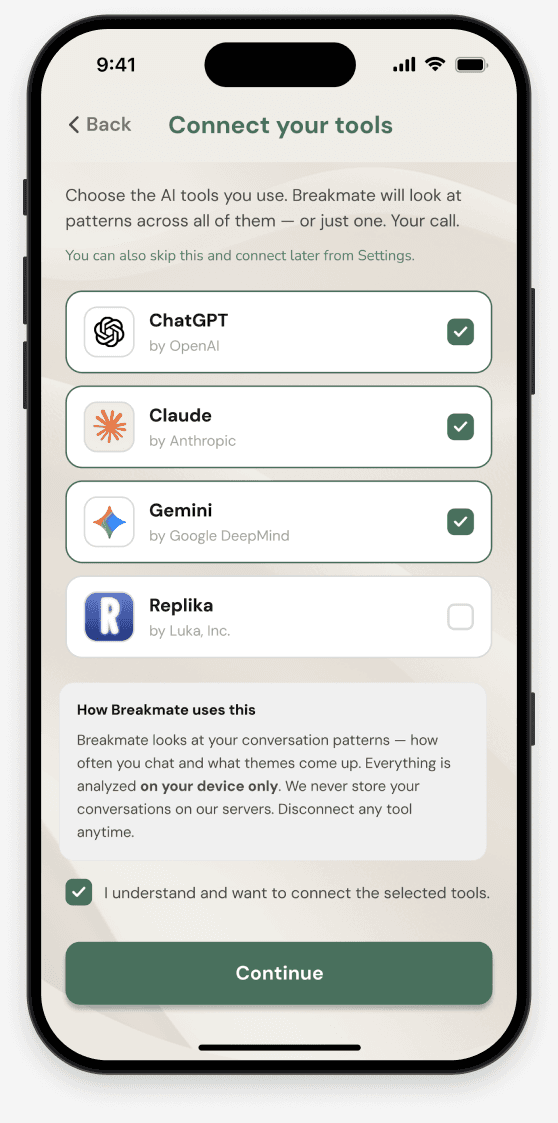
02 · Consent
Ask for access with the privacy promise in view
People choose which tools to connect and see that analysis stays on their device before agreeing.

03 · Personalize
Start from values, not settings
Knowing what someone cares about lets later nudges point back to their own priorities.

04 · Patterns
One view across every AI tool
Usage is combined because no single app can show the whole pattern. That was the core gap we found.
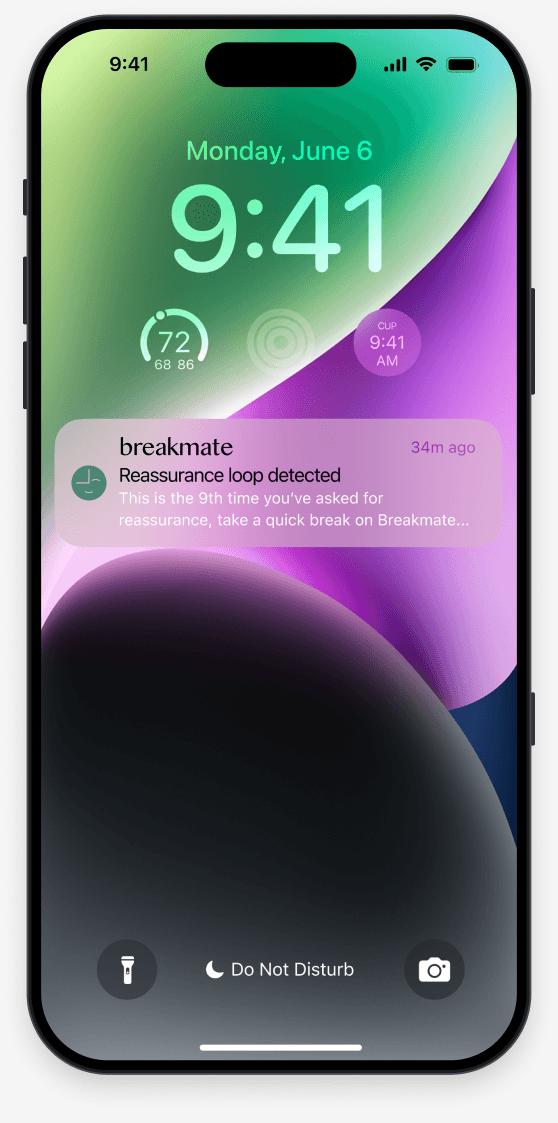
05 · Detection
Name the loop, gently
The nudge names the repeat (“the 9th time you’ve asked”) and offers a break instead of blocking.

06 · Guided pause
Make the pause a moment to reflect
What survived of our first idea, the postcard: people write a note to open later and choose when their AI apps reopen.

07 · Limits
Limits the user sets, not ones we impose
Locked apps show when they reopen, so a limit feels like a choice, not a punishment.

08 · Human support
Make the hand-off real
Nearby, affordable support is one tap away, because detection alone rarely gets people to call. (Providers shown are examples, not partners.)
What testing changed
Our first idea didn’t survive testing
Eight people tested it across two rounds in August, with a redesign in between. This is the biggest change. The five smaller fixes are in the director’s cut.
Round 1 · our first idea
A postcard to your future self
At the center was a postcard: a note about a decision, sent to your future self and returned later to interrupt the reassurance loop.
What testers did
Four of five couldn’t say what the postcard did until we explained it, and even then it didn’t feel like it would change anything. The fifth liked its playful, game-like feel. All five liked the goal; the postcard just wasn’t the way to get there.
Round 2 · after the redesign
A loop alert and a way back to people
We rebuilt around what testers could act on: self-set app limits, a loop alert, exercises matched to their values, and a hand-off to a real person.
What testers did
All three called it straightforward. None got lost, so they hunted for flow problems and found two: the dashboard jumped back to the top when you returned to it, and the values quiz let you continue with one pick when it asked for two or three (both are fixed in the prototype below). They liked the look and the welcome note, and the analytics gave just enough to dig deeper. Most of all, they weren’t left alone with the numbers: exercises, app limits, nudges, and a way to reach people they trust.
“If you make it real, I will download this because I need it.”
A round-2 tester, after the redesign
Qualitative notes. The team didn’t record timings or task completion, so there’s no task-success rate. A timed retest of the final flow is the next step.
Prototype
Walk through Laura’s path yourself
This is the clickable prototype we demoed at the final pitch. Try the whole journey yourself.
How to use it
The intro plays on its own. Then click to move forward: connect your AI apps, check the pattern dashboard, take a guided pause and find support nearby. Press R to restart.
Open full screen ↗
Concept prototype. Data and support providers are examples.
Outcome
What happened, and how we’d know it works
Breakmate is a concept with a tested prototype, not a launched product. This section separates what we built from what comes next.
Done
What we delivered
• 21 interviews: 13 AI users, 7 support professionals, 1 AI expert
• Competitive analysis of assistants and wellness chatbots
• Several rounds of wireframes, from lo-fi to a final prototype
• Eight usability tests and the iterations above
• A final pitch and live demo, closing a 170-hour UX Design Apprenticeship
Proposed
What comes next
• A first institutional pilot (e.g., a university counseling center)
• Deeper testing of the pause and discover flows
• In-chat detection
• A technical spike to confirm cross-app data access
Metrics
How we’d measure success
• Users can explain the patterns we show them
• Guided-pause completion rate
• Self-reported sense of agency, before vs. after
• Support taps that turn into real contact
• False-positive rate of loop detection
Pitch day
One big pitch for all our work
Breakmate closed with a live pitch to the room at BRIDGEGOOD’s Purpose to Pixels showcase. We proposed the problem, current solutions that are not working, and how Breakmate is the solution through our demo.
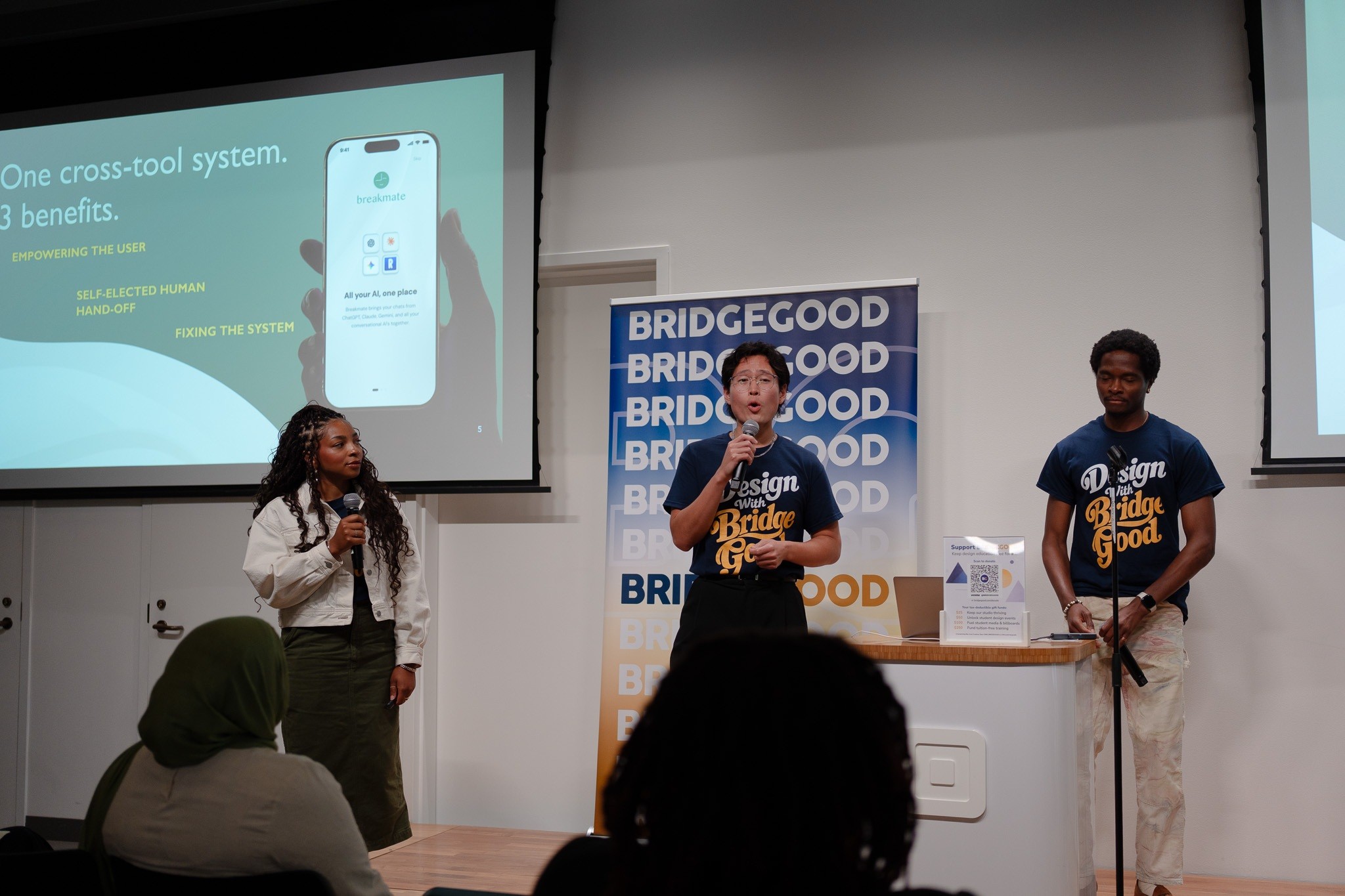
Pitching Breakmate at BRIDGEGOOD’s Purpose to Pixels showcase.

Receiving the UX Design Apprenticeship certificate.

The UX Design Apprenticeship certificate, which carried a $12,500 award.

The BRIDGEGOOD apprenticeship cohort.
Reflection
Next time, test the hard part first
Test the riskiest assumption first
A product advisor from Adobe named the risk: big AI apps want more use, not less, so they have little reason to let us in. Privacy, telling work chats from personal ones, and browser workarounds were open questions too. I’d test access before polishing screens.
Prototype the hand-off, not just the nudge
Our research pointed at the hand-off as the weak spot. The next round should test whether people actually reach a person.
Say why it works, not just what it does
Our mentor pushed back that “self-reflection isn’t a problem solver itself.” It changed how I led the pitch: reflection is the stepping stone, rebuilt self-trust is the outcome.
Director’s cut
Want to see the making of Breakmate?
This page is the six-minute cut. The director’s cut adds the research behind the insight, three more decisions, an expert’s review, the design system and pitch day. About six more minutes.
© 2026 Moe Htet
·
Updated September 2026
·
Los Angeles, 8:27 PM