6 min read · Director’s cut +4 min
Founder project · Consumer goods · 2025 – 26
MOKIO Coffee
Most bags tell you the country. MOKIO tells you the village.
A single-origin coffee from Ekoheto Village in the Flores highlands of Indonesia.
$4.97
to make one 250g bag
$389
to register with BPOM, the Indonesian FDA
$349
a year for a US agent
$1,485
to land the first 80 bags, all in
My first-run estimates, made before a single bag was ordered.
Credits
Role
Founder
Team
Co-founder Myat Ko (LLC and banking), and a manufacturer in Indonesia
Timeline
Feb 2025 – Jan 2026 (site live Sept 14)
Status
Site and MVP live
I owned
Brand and label design, manufacturer sourcing, the pre-sale site, social marketing

In 60 seconds
The short version
The opportunity
A local favorite with a story worth selling
Flores coffee from Bajawa is grown at 1,400m in volcanic soil by farmers in Ekoheto Village. The origin story was strong; it just wasn’t packaged for buyers here.
The decision
Launch one product, and build demand first
One single-origin medium roast in one bag, released first to an email-only early-access list of “founding members.”
The result
14 interest-list sign-ups, a live site, and an MVP shipped
I took MOKIO from a sourced bean to a running business: the LLC, the bank account, the domain, an FDA-compliant label I designed, a manufacturer I found and negotiated with, and a live site whose interest list 14 people joined. The coffee is waiting on a compliance step at the supplier before it can be imported.
The problem
Three questions before anything could ship
Going from a coffee I loved to a product someone could buy meant answering these in order.
01 · Product
What exactly are we selling?
A single coffee, not a range, with flavor notes a buyer could picture before tasting it.
02 · Package
How does a bag earn trust on its own?
Put the origin story and a brew guide, including traditional kopi tubruk, on the label.
03 · Channel
How do we reach first customers on a small budget?
A discovery website with email capture and AI-assisted imagery, plus in-person sampling at local farmers markets.
Brand + packaging
A print-ready label in three rounds
Three rounds took the label from a first draft to print. The shelf research and first AI concepts behind it are in the director’s cut.

Round 1
First submission to the manufacturer: 6.5 × 11 cm front and back labels, with bleed marked for cutting.

Round 2
Scaled up to 10 × 14 cm after the print test below showed the pouch was wider.

Final
Print-ready front and back labels.

Between rounds 1 and 2 · Print test
The first print came back too small
Our manufacturer printed round 1 on a sample pouch and sent photos of it beside one of their own bags. The printing and the design worked. The size didn’t: next to their 10 × 13 cm label, ours looked narrow on the pouch.
I’d sized it from measurements they gave me earlier. We measured the real pouch together before round 2.
The print test photo (the manufacturer’s branding removed).

Logo explorations, narrowed to one mountain mark.
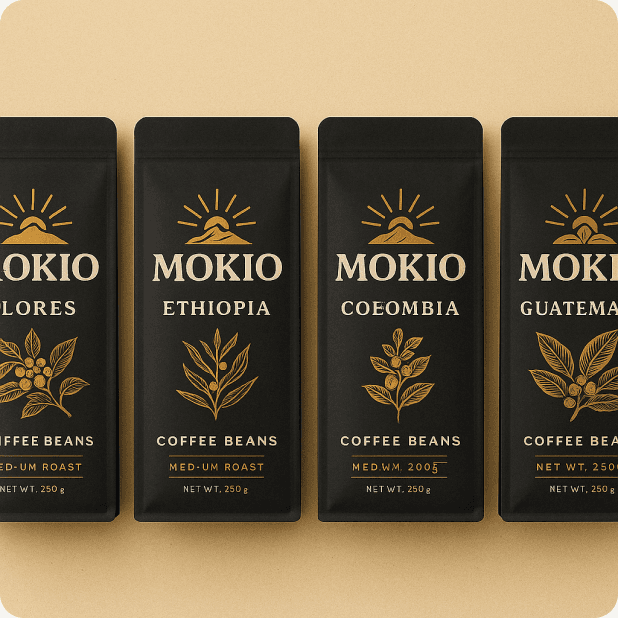
A label system built to scale: the same layout works for future origins.
Key principle
“On a shelf or a screen, the bag has to tell the origin story on its own.”
So everything we made, from the label to the site, leads with the place before the price.
Decisions
Five calls I made as a founder
Each one traded speed or polish for spending less before we had a single customer.
The question
How many products at launch?
We chose
A single Flores roast from Bajawa, bolder than the Bali Kintamani our manufacturer also offered.
What we cut
A second product. I designed a civet coffee label, then set it aside because those beans are produced slowly and couldn’t keep up with a launch.
The question
Custom-printed pouches, or labels on stock pouches?
We chose
A printed sticker label on a stock aluminum valve pouch: $0.19 a label, cheaper and faster than a custom run.
What we cut
Custom-printed pouches, which needed about 5,000 bags for a first run of 80.
The question
Book a studio shoot, or use AI imagery?
We chose
Real samples from our manufacturer, turned into studio-quality images and short videos with AI tools.
What we cut
A professional photo shoot. Too expensive before any revenue.
The question
Sell now, or build a list first?
We chose
An email-only pre-sale list for “founding members.” 14 people signed up.
What we cut
Opening checkout before the first roast was ready.
The question
What does the label need to do?
We chose
Tell the origin story and teach brewing, including kopi tubruk.
What we cut
A minimal front that leaves the story to the website.
What’s outstanding
Our side shipped. One step sits with the supplier.
Myat Ko handled the company setup, including our FDA facility registration. I sourced the manufacturer and built the MVP with an FDA-compliant label. The one step we don’t control is the factory’s own registration, and that is what the coffee is waiting on.
14
interest-list sign-ups
1
live site and MVP shipped
1
step outstanding at the supplier
Where it stands
The step sits with the factory, not the brand
Any foreign facility making food for US buyers has to clear a registration step before its product can be imported. Ours is still open on the manufacturer’s side, so the coffee is waiting while everything around it is built and live.
What was at stake
Everything on our side was done
Myat Ko formed the LLC and registered it with the FDA as a US food facility in June 2025. On my side: a label that met FDA labeling rules, samples, a live site, and 14 people waiting to buy.
What I’d do now
Verify the supplier before building the brand
Choose a manufacturer that is already FDA-registered, or line up a US agent and confirm the registration number, before paying for design and samples.
Outcome
What happened, and what a relaunch would measure
Done
What I delivered
• LLC, business bank account, and FDA registration (Myat Ko); domain, Google Business, and social accounts (me)
• MVP produced with our manufacturer in Indonesia; label built to FDA labeling rules
• Pre-sale site live Sept 14, 2025, with email capture (now archived at mokiocoffee.netlify.app)
• AI-assisted product images and videos
• Social accounts on four platforms, ready for launch
Results
What happened
• 14 people on the early-access list
• Site and interest list live, bags not yet shipping
• Import waiting on a compliance step at the supplier
• Most sign-ups arrived right after launch
Metrics
What I’d track on a relaunch
• Visit → sign-up conversion
• Sign-up → first order
• Repeat purchase within 60 days
• Time and cost to clear import compliance
Interest-list sign-ups by month
Sep 2025 (launch Sep 14)
8
Oct 2025
4
Nov 2025
1
Dec 2025
0
Jan 2026
1
Counted from Sep 14, 2025 to Jan 22, 2026. One test entry excluded.
What the list told me
Interest peaked at launch, then faded
8 of the 14 sign-ups came in the first two weeks after launch. After that, new sign-ups slowed to a trickle.
The referral feature went unused
Every sign-up got a referral link. Nobody used one, so there was no reward strong enough to share.
I couldn’t tell which channel worked
All 14 came from our organic and paid social posts, which sent people to the interest-list form on the site. But only one sign-up carried its source (a Facebook link), so I couldn’t tell which posts worked. Next time every link gets UTM tags from day one.
Reflection
What building the whole thing taught me
Vet the supplier’s compliance, not just mine
My own compliance was done, but the launch depended on my manufacturer’s. When I first asked in April, they believed FDA steps happened on the US side. Next time I’d make FDA registration a condition of the deal, not something to check after the brand work.
Set a demand target before the list
Fourteen sign-ups from a mostly warm audience is an early signal, not demand. Next time I’d set a target that justifies a first production run, and track where every sign-up comes from.
Don’t depend on one supplier, and set expectations in writing
The same company was my supplier and my manufacturer, so when they stalled I had no other product to sell. I also never agreed on deadlines or commitments with them, which made it hard to get their tasks done.
Director’s cut
Want the long version?
This page is the six-minute cut. The director’s cut adds the design brief, shelf research, the product and its costs, the launch plan, the storefront and the AI imagery. About four more minutes.
© 2026 Moe Htet
·
Updated September 2026
·
Los Angeles, 8:23 PM