6 min read ·
Client challenge · Dassault Systèmes · USC Iovine and Young Academy · Oct 2026
ATELIA
The know-how Donald needed already existed. It was locked inside another company.
A five-day product strategy residential with Dassault Systèmes. Our team of four proposed a 3DEXPERIENCE plugin where an engineer pays per run to use an expert’s proven process, and the expert never sees the design.
5 days
from a blank brief to a pitch to Dassault’s leadership
4 of 4
guiding questions from Dassault’s experts the concept had to answer
6 of 8
cohort futures it survives, with the two it breaks in named
2028
the wedge, with the trajectory argued through to 2031
Five days at USC Iovine and Young Academy, 1 to 5 October 2026. Thirty-three students, eight teams, one brief from Dassault Systèmes.
Credits
Role
Product strategy resident
Team
Four. Melissa, Moe, Chloe, Krystal
Client
Dassault Systèmes
Timeline
1 to 5 October 2026
I owned
Signals research, the reality check, feedback synthesis, and the interactive demo

The cohort: thirty-three students in eight teams, with the four Dassault experts in the front row. The other seven teams reviewed our work across four rounds.
The problem
Why nobody will just tell him
Donald K. is 33, an electrical engineer at a small hardware startup in Los Angeles. He has to fit a 44 mm board into a 38.1 mm slot in a rugged enclosure. Nobody on his team has built a drop-proof layout before. He models it, sends it to the fab, and two days later gets back a list of the two points where it will fail. Then he reworks it and waits again.

Donald’s week today: model, send, wait, rework. Each loop costs days and another prototype.
Experts will not share without control
Their process is their IP. Handing over the method means handing over the thing they sell.
There is no way to be paid per use
Know-how sells as consulting hours or as a full licence. There is nothing in between.
The data cannot leave the company
A shared pool of design data is neither credible nor wanted. Every peer review round told us the same thing.
Key insight
Sell runs of the process, not the process
Somebody has already solved Donald’s problem. He just cannot get at how they did it, because every route an expert has for sharing a method ends with the expert handing over the thing they actually sell.
So we stopped trying to move the knowledge and moved the result instead. A maker packages a proven process as a skill, Donald runs it inside his own workspace and pays for that run, and the seal holds both ways: the maker never sees his design, and he never sees their process. No open data pool, and every skill carries identity, permissions and accountability.
The futures work
We chose the world where people still decide
Each of us brought five dated signals, we grouped them into forces, then put two of those forces on axes and wrote the worlds in each quadrant.
My signals were the maker and prosumer economy
Figma’s S-1 showing two thirds of its 13 million monthly users are not designers. Onshape giving away CAD with AI agents attached. Both made the final deck.
My world was “Adopt Me”
International competition with human-led judgment, a national AI race. The team took the opposite corner.
We built on Intellectual Harmony
International collaboration with human-led judgment: technology handles the routine work, expertise moves across borders, and people still set the direction.

The quadrant. Our world sits top right: expertise crosses borders, people keep the judgment.
The cut
Two ideas we dropped, and the one we kept
I ran a reality check against Dassault’s current offer and against Siemens with Xometry, Autodesk’s Design and Make Marketplace, Catena-X, MakerWorld and Salesforce AgentExchange. Three ideas went in and only the third survived the scan.
Dropped
One shared AI trained on pooled client data
It breaks Dassault’s own promise that your data never leaves, and Siemens already ships a version of it.
Dropped
Pooling prices between competitors
Antitrust.
Kept
A process library with licensing
The scan found no B2B marketplace for licensing manufacturing process know-how, which is the gap ATELIA sits in.
What feedback changed
Four rounds, each one narrowing it
I synthesized the peer feedback after every round. The concept got smaller each time, and that was what we wanted.
Round 1
Too broad
We started at “Dassault as the one-stop shop for hardware.”
Round 2
Pick a user
Donald arrived here.
Round 3
What is actually new?
Matching and licensing resonated. A shared data pool did not.
Round 4
Show the money
Orders, royalties and access only work if the split is on the page.
Every single group asked the same question: why would anyone share?
From our Dassault sponsors
Abhishek Bali · Director, Mainstream Innovation
Study FabLabs and maker spaces. Startups mostly work alone today, and the experts who stay in one lane help them most.
Suchit Jain · VP, Strategy and Business Development
Co-creation can cross company boundaries, but people will not share supply chain data or IP. Let companies teach models with their own data.
The product
How a skill gets made, sold and paid for
A maker packages a proven process as a skill. Dassault certifies it and seals every run inside the buyer’s workspace. The user approves and pays per run, and the maker is paid for it. Every result carries the maker’s mark.

Contribute, verify, protect, run, earn. The maker never has to meet the buyer at any point in it.

Expert workflows become private, paid skills inside 3DEXPERIENCE. Dassault operates the foundation: review, protected runtime, data privacy and billing.
The demo
I built the thing we were describing
Slides can claim a flow takes one sitting instead of one week, but nobody believes a claim like that until they watch it happen. So I built a clickable 3DEXPERIENCE workspace that walks the whole loop, and we ran it live in the pitch in about two minutes.

LEO spots the misfit in SOLIDWORKS xDesign: the board is 44 mm, the slot is 38.1 mm, and the rail interferes by 2.95 mm.

Human sign-off. Donald sees the maker, the permissions and the price, 120 blue tokens, before anything runs.
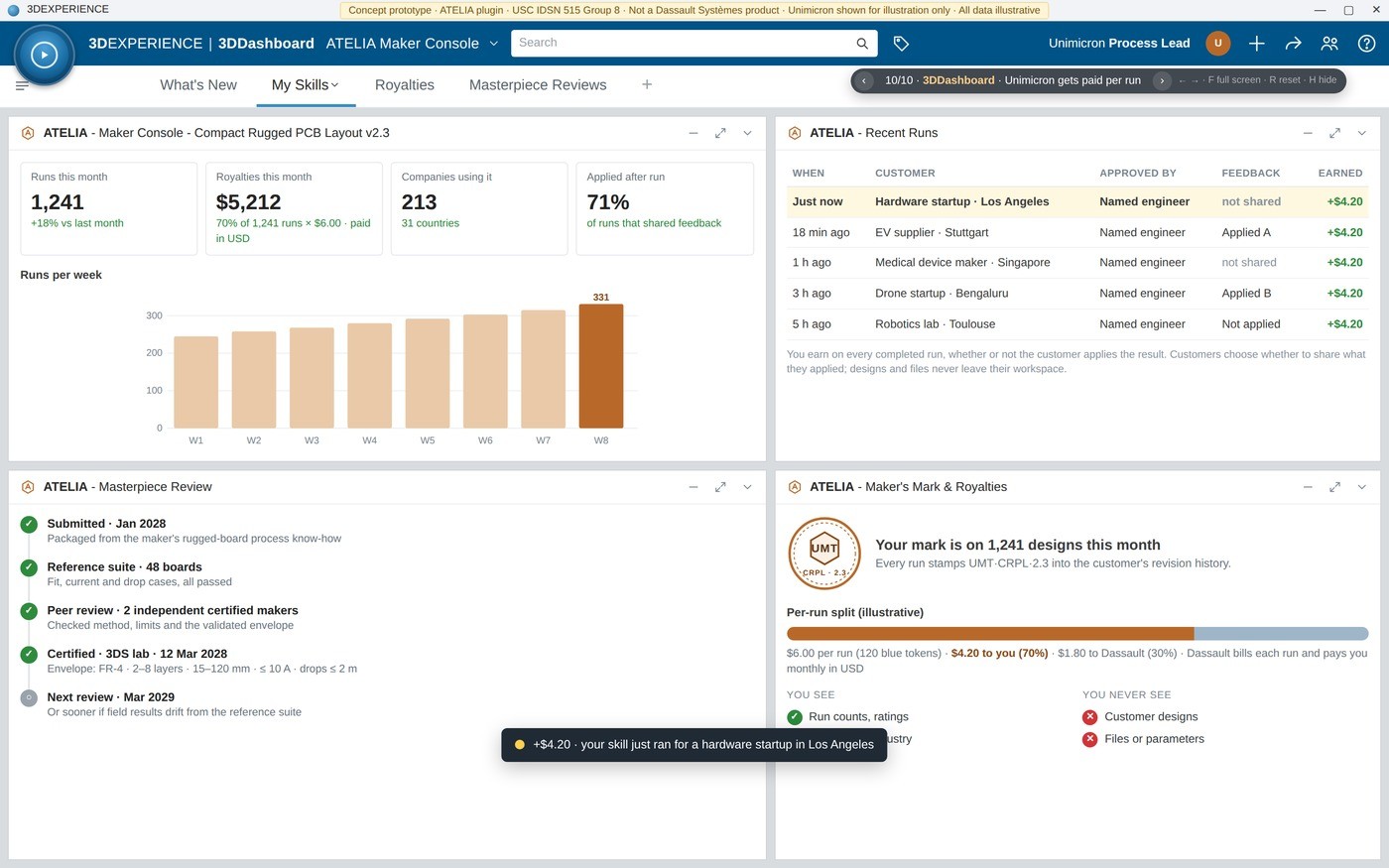
The maker’s console. The run is logged, the mark is recorded and the royalty is paid.
Concept prototype. Not a Dassault Systèmes product. Unimicron shown for illustration only, all data illustrative. Best on a laptop.
The business model
No new currency. No new purchase order.
ATELIA runs on blue tokens, the currency Dassault customers already buy for AURA, LEO and MARIE. A team can try an expert skill the same day, out of a balance they already hold.
$6 a run
120 blue tokens, charged on every completed run whether or not the result is used. Nothing is charged if a run cannot complete.
70 / 30
$4.20 to the maker, $1.80 to Dassault. Makers price inside Dassault’s bands and are paid monthly.
$5,212
to the maker at 1,241 runs a month, and $2,234 to Dassault.
Blue tokens are Dassault’s existing currency for AI skills on 3DEXPERIENCE, 25,000 for $1,250 a year. Prices and volumes here are illustrative.
The stress test
The two futures it does not survive
Every team in the cohort wrote a world. We tested ATELIA against all eight, not just our own.
Holds
AI is a public service, like the library
Like library books, skills need funding and upkeep.
Holds
AI companies self-regulate, human expertise is valued
Human expertise is exactly what ATELIA sells.
Holds
Founder’s paradise, no barriers to making
More makers means more demand for proven know-how.
Holds · our world
Technology handles routine labor
Skills have to stay expert-level, never routine.
Holds with gates
Certified access to frontier models
High-risk skills, defence for example, only for certified users.
Holds if Dassault hosts
One central system holds every product passport
Every skill traces to its maker inside 3DEXPERIENCE.
Breaks
Machines lead judgment, near-instant simulation
Expert skills matter less when machines decide. Hedge: keep skills expert-level and human-approved.
Breaks
Living digital twins learn from shared data
We do not pool data. Hedge: opted-in twin data can improve a maker’s own skill.
The path
Start narrow. Grow into a marketplace.
2028, the wedge
One certified skill for one job: compact, drop-proof PCB layouts, for teams on 3DEXPERIENCE for Startups.
2031, the trajectory
AURA, LEO and MARIE call ATELIA skills across design, simulation, manufacturing and compliance, for every 3DEXPERIENCE user.
The next test
One maker, one startup team, one skill. Measure first-time-right fits and days saved.
Outcome
What Dassault’s team said
We pitched to Suchit Jain, VP of Strategy and Business Development, alongside Angela Smith, Tony Tsao and Abhishek Bali. What they responded to was that ATELIA is built out of Dassault’s own parts: blue tokens, LEO, CATIA, SIMULIA, 3DDashboard and 3DEXPERIENCE for Startups. They said it could begin being implemented now and had a good trajectory into 2031, and that they would be taking it to their internal team to go deeper.

Group 8 with Angela Smith, Suchit Jain, Tony Tsao and Abhishek Bali, pitch day, 5 October 2026.
Reflection
The three things I would test before believing it
The cold start is unsolved
Why would the first maker package a process for roughly five thousand dollars a month? We modelled the split, but no maker has told us it is worth their time.
The liability split is a hypothesis
We wrote down who is accountable for what. No lawyer and no maker has checked it.
The one-day storyboard is only a scenario
It shows what the flow would feel like. It is not a result, and I have not treated it as one.
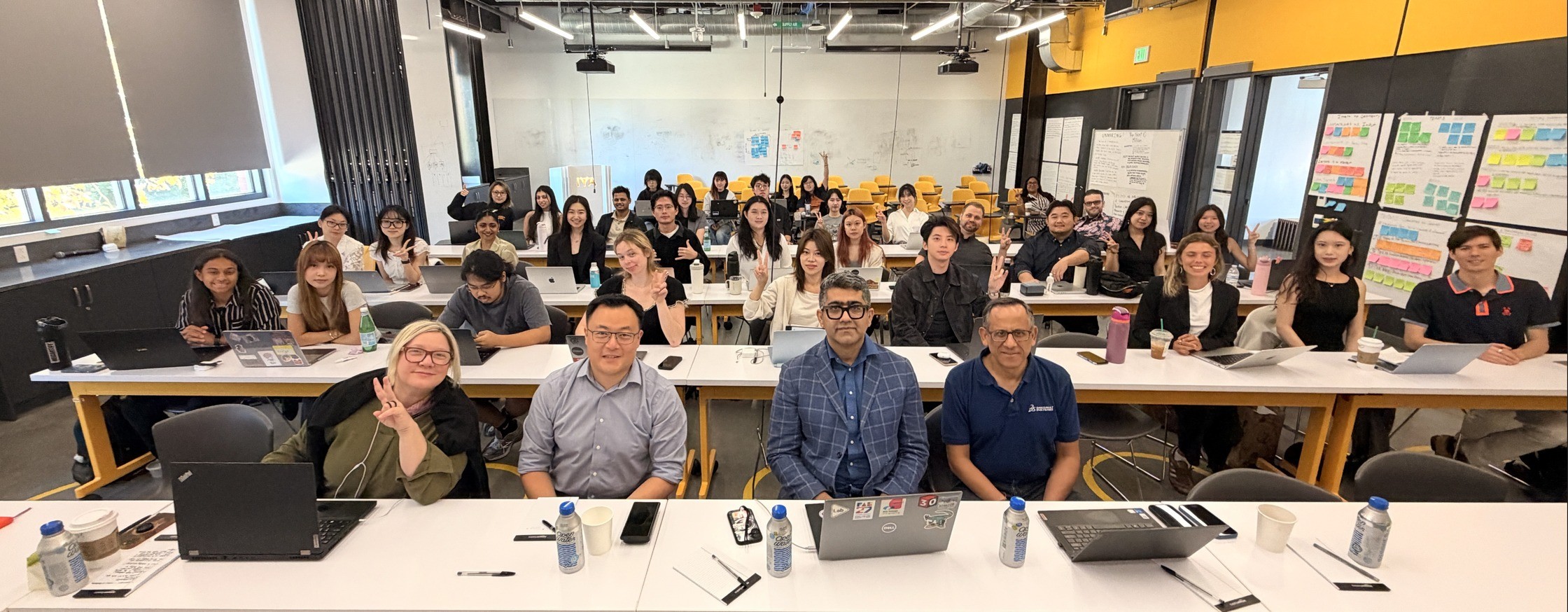
The cohort: thirty-three students in eight teams, with the four Dassault experts in the front row. The other seven teams reviewed our work across four rounds.

Group 8. Melissa, Moe, Chloe and Krystal, USC Iovine and Young Academy, October 2026.
Dassault Systèmes, 3DEXPERIENCE, CATIA, SOLIDWORKS and SIMULIA are trademarks of Dassault Systèmes. This is my own case study of a student residential, not affiliated with or endorsed by Dassault Systèmes.
Director’s cut
Want to see the making of ATELIA?
This page is the six-minute cut. The director’s cut adds the signals behind the forecast, the quadrant we argued over, the concept we abandoned, four rounds of peer review and the mentors’ notes. About eight more minutes.