6 min read
Academic strategy project · SF State · Marketing · Fall 2022
Sagacity Tea
Arizona sold $650 million of iced tea in a year. Sagacity sold $2.5 million.
A growth strategy for the small brand that doesn’t require outspending the giant.
$2.5M
in annual sales. Arizona sold $650M.
5%
of sales online. Category average is 20%.
3
routes to market, costed end to end
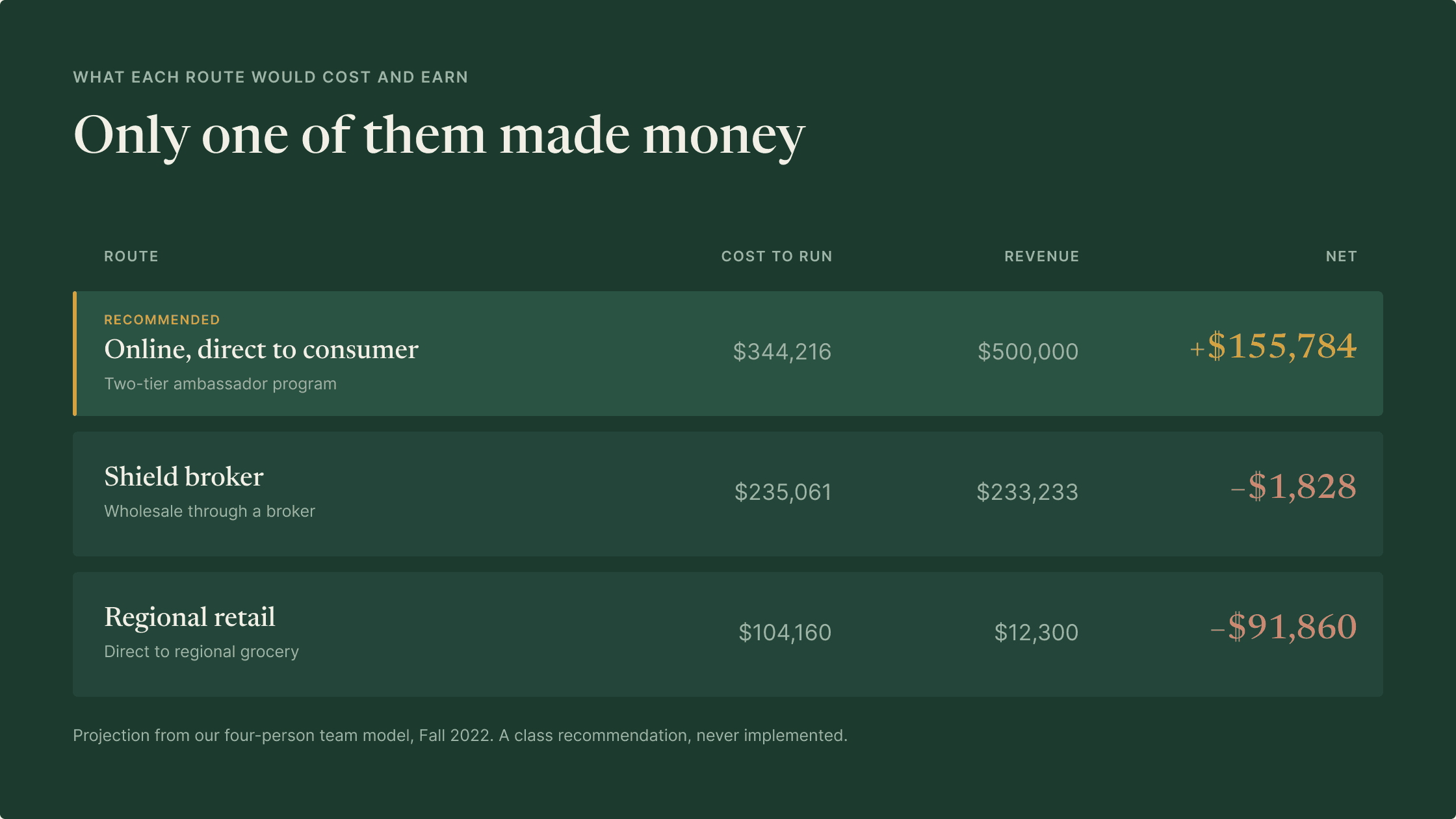
+$155.8K
projected net on the route we recommended
The first two are where Sagacity stood. The last is a projection, not a result.
Credits
Role
Strategist on a 4-person “outside firm”
Client (case)
Sagacity, ready-to-drink tea · CEO Kate Moran
Timeline
Fall 2022
Status
Academic recommendation (not implemented)
I owned
Targeting and positioning, plus the go-to-market plan
In 60 seconds
From 5% online to a 12-month plan
The problem
Growth was capped by physical retail
Sagacity sold through 450 retail outlets, but only 5% of sales came from online. It wanted to expand without handing distribution to a broker.
The recommendation
Borrow reach through ambassadors
A two-tier ambassador program (NYU students first, then niche influencers) tied to trackable discount codes and backed by an online store and an Amazon listing.
The plan
12 months, with targets and a budget
Targets: lift online share from 5% to the 20% category average and reach $500K in revenue, on a first-year budget of about $148K.
Constraints
What we couldn’t change
Good strategy starts with the rules of the game. The case set three.
Rule 1
Keep the premium price
Sagacity prices on value. Cutting price would weaken the premium image, so discounts had to be targeted, not blanket.
Rule 2
No new products
The three existing teas stay the line-up, from Himalayan white to Taiwanese oolong.
Rule 3
No broker
Growth outside the home market had to come from Sagacity’s own channels.
Target markets
Where premium tea already has fans
Positioning: for tea lovers who value a premium, locally crafted ready-to-drink tea that is flavorful and low in calories.
Beachhead
NYU students
Greek life and the Latino community on campus. In tight networks, one trusted voice travels far.
Core buyers
Health-minded millennials
Health-focused buyers and locavores shopping within 100 miles.
Communities
Asian and Hispanic households
Groups with strong tea cultures, reachable through foodie and lifestyle creators.
Geography
High tea-drinking cities
New York City, Philadelphia, Baltimore, Buffalo, Schenectady, and Troy.

The bet
“Trusted voices reach people more cheaply than ads, as long as every recommendation can be tracked.”
So each ambassador and influencer gets a personal discount code: it rewards them and tells Sagacity exactly which voices drive online sales.

Decisions
Five calls in the plan
Each recommendation had a cheaper or flashier alternative.
The question
How do we grow without a broker?
We chose
Sagacity’s own online store and Amazon, fed by an ambassador program.
What we cut
A brokerage deal. Faster shelf space, but less control over brand and margin.
The question
Compete on price?
We chose
Keep value-based pricing and discount only through ambassador codes.
What we cut
Across-the-board discounts that would erode the premium image.
The question
Launch a new flavor for buzz?
We chose
Stay with the three existing teas.
What we cut
A fourth flavor, about $10K to develop before any sign of demand.
The question
Big influencers or campus voices first?
We chose
Two NYU student ambassadors first, then two larger niche influencers.
What we cut
Leading with big influencers. They cost more and are less trusted inside tight communities.
The question
Which paid channels?
We chose
Social ads on Meta and TikTok, plus SEO for the online store.
What we cut
Google Ads as the lead channel.
The slides behind these calls

Distribution strategy
Call 1: I mapped the channel options before we chose our own channels and ambassadors over a broker.

Product strategy
Call 3: I flagged new flavors as an opportunity. The plan held them until the three teas showed demand.

Marketing communications
Calls 4 and 5: the mix of events and word of mouth that the ambassador and paid-social choices came from.
The program
How the ambassador engine runs for a year

Jun – Aug
Recruit
• Post listings on social and Handshake
• Reach out to Greek life and campus clubs
• Sign ambassadors and ship first cases
Sep – Dec
Activate
• Posting schedule starts
• Campus tabling with samples and QR flyers
• Discount codes go live; first campus visit
Jan – Apr
Review and scale
• Second shipment; set next year’s goals
• More campus visits
• Year-end review of the numbers before renewing
Student ambassadors
What they commit to
• 1 Instagram post a month, 1 story every two weeks
• A TikTok mention every two weeks; 1 promoted Sagacity video a month
• Tabling at student-life festivals
• In return: 2 free cases, plus cases for big events
Influencers
What they commit to
• 1 Instagram story and 1 post a week
• A weekly TikTok mention; a dedicated video every two weeks
• Followers get 10% off with their code
• In return: 30% of customer savings as pay, or 50% as product credit
First-year budget
Where the ~$148K goes
Estimated costs from our plan, by line item.
Ad promotions
$88,966
Technical support for the online store
$30,000
Logistics
$19,250
Software and website design
$6,000
Influencer royalties
$1,901
Product for ambassadors (68 cases)
$1,436
Total: $147,552 · Ad promotions are 60% of the budget.
Outcome
What we delivered, and how success would be judged
Delivered
A complete marketing plan
• Executive summary and objectives
• Product, pricing, place, and IMC strategy
• Action plan for two ambassador tiers
• Budget and a 12-month timeline
Targets
Set by the plan, not achieved
• Online share of sales: 5% → 20%
• Revenue: $500K
• Profit objective: $155,784
Metrics
How I’d track it
• Code redemptions per ambassador
• Online share of sales, monthly
• Cost per acquired customer, by channel
• Instagram CPC vs. the $0.40–$0.70 benchmark we researched
From the original work
Two more of my slides from our Fall 2022 team deck, one team slide on costs, then four pages of the written plan.

Target markets

Positioning and brand mantra

Cost proof, a team slide

Executive summary

Target markets and IMC

Action plan

Budget
Reflection
What I’d challenge in our own plan
Our budget contradicted our thesis
We pitched low-cost, trust-based reach, yet 60% of the money went to paid ads. Today I’d rebalance the budget or explain why ads were still needed.
Build the target from the bottom up
We set 5% → 20% online share without estimating how many code redemptions that takes. I’d model the funnel first.
Audit the numbers
One budget line listed 248 cases at a cost that only works for 48. Small errors like that cost trust with a real client.
© 2026 Moe Htet
·
Updated September 2026
·
Los Angeles, 8:29 PM